©Christopher Tyree, All Rights Reserved
22 September 2025
The economy is walking under its own power but only because AI is acting as a brace. Strip that away, and the underlying patient is fragile — with stagflation still the dominant concern.
The past week brought two developments that matter more than the daily market chatter: the Federal Reserve cut interest rates for the first time this year, and President Trump signed an executive order restricting H-1B visas. One was a painkiller, the other a tourniquet. Together they tell a story of an economy being propped up for now but left with less room to heal.
The Fed’s cut buys short-term relief for households and businesses struggling under high borrowing costs. But paired with tariffs that continue to raise prices, the move risks keeping inflation stubborn even as growth slows — the classic stagflation trap. Investors cheered, but the underlying imbalance remains.
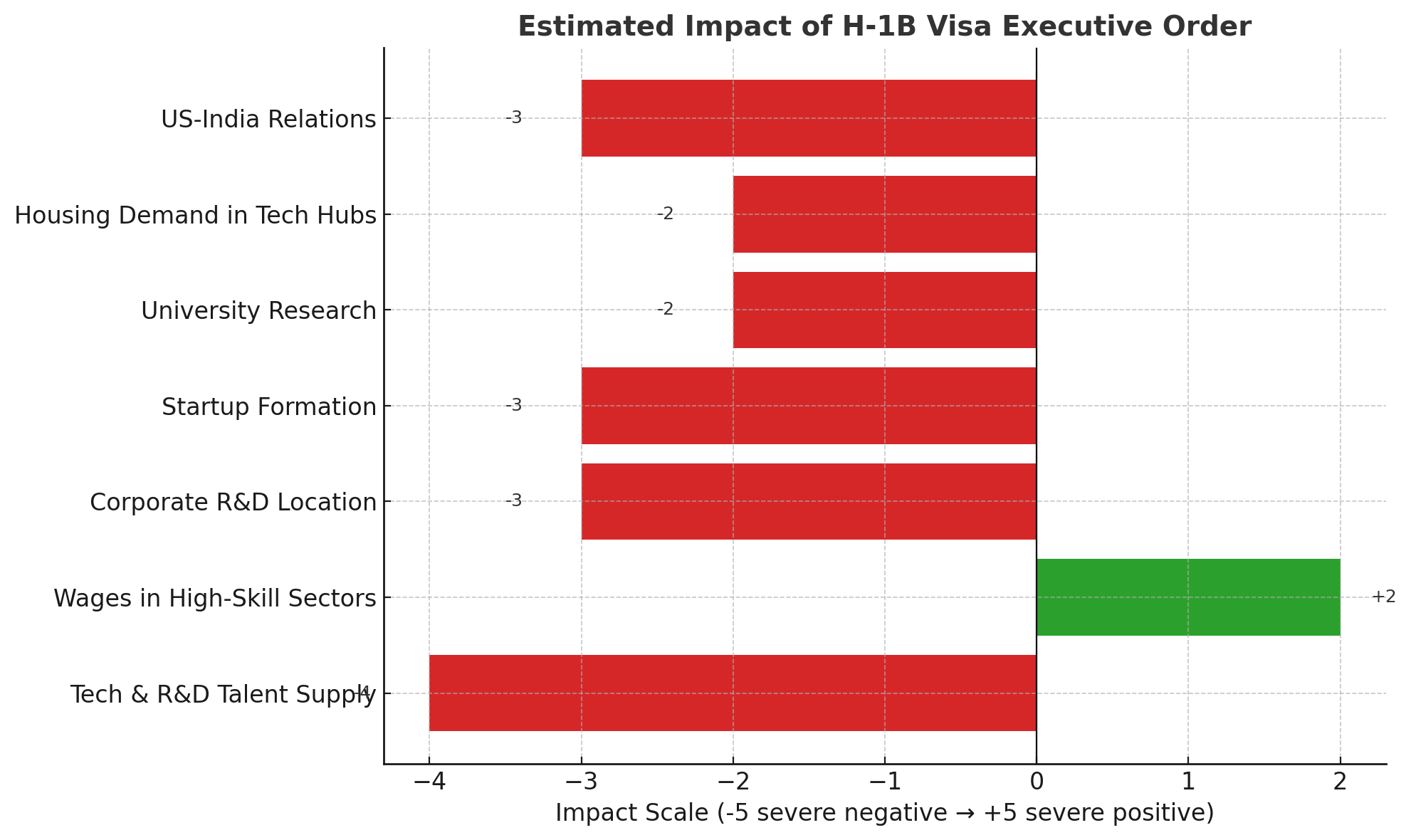
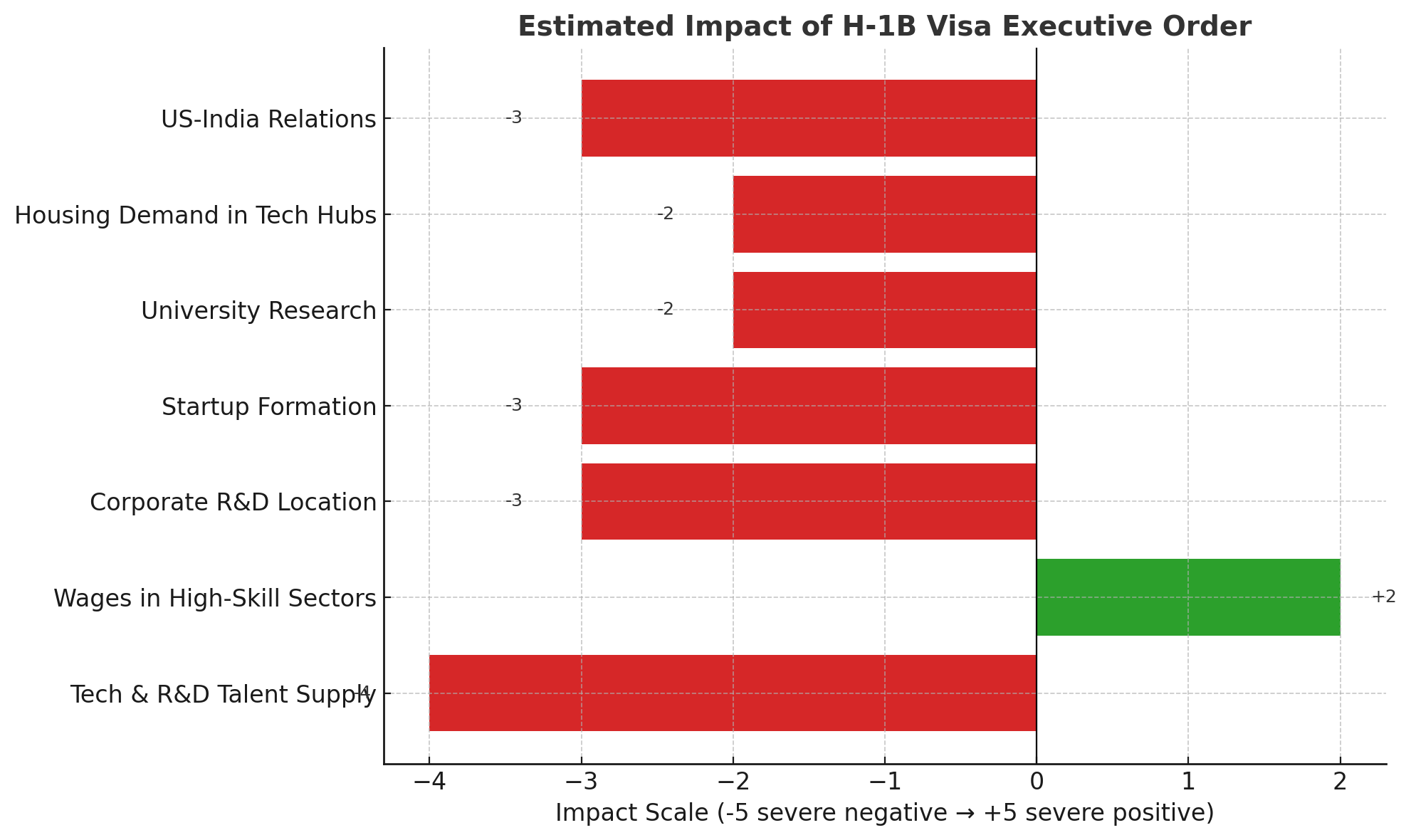
Wages increase because of the scarcity of high tech labor due to the EO but also because of lack of funding to research institutions by the administration.
The H-1B order cuts deeper. For decades, high-skilled immigrants, especially from India, have powered U.S. research, engineering, and medical progress. Shutting down that pipeline means companies will push more R&D abroad and the U.S. brain trust will slowly erode. It’s the kind of decision that doesn’t register in this quarter’s numbers but shapes the country’s trajectory for decades.
Meanwhile, the foundations of resilience — housing, cars, tourism, philanthropy — are softening. Homes are lingering on the market even as mortgage rates ease. Used cars are cheaper to buy but more expensive to repair. Hotels are reporting weaker bookings as summer closes. Even nonprofit giving, long a quiet stabilizer in tough times, is showing signs of donor fatigue.
Taken together, these headlines suggest an economy that’s still standing but increasingly brittle. AI investment is holding up the frame for now, but if that spending slows or global shocks hit, the cracks could widen quickly. The path forward is less about avoiding pain and more about whether the country can absorb it without breaking.
Vitals
Pulse (Labor): ADP shows sluggish job gains (+54k), mainly in health care and AI. Indeed/LinkedIn postings are flat. Wages rising 4.4% y/y keep pressure on costs.
Blood Pressure (Prices): Tariffs and food costs remain inflationary. Relief from cheaper oil (~$63/bbl) and lower freight rates, but sticky in core goods.
Oxygen (Consumer Demand): Pending home sales only +0.8% y/y. Mortgage rates ~6.3%. Households cautious; grocery bills and medical costs weighing.
Mobility (Housing/Autos): Housing inventory rising, making it the “strongest buyer’s market in years.” Wholesale used car prices flat; repair costs up.
Circulation (Logistics/Tourism): Trucking spot rates subdued. Hotel RevPAR down in September, signaling softer travel demand.
Stress Test (Markets/Credit): HY spreads at ~2.7–2.8% (calm). VIX ~15–16. Equities still propped up by AI investment.
Doctor’s Notes
Diagnosis: Without AI spending, the economy would already look stagflationary. Growth is weak, prices sticky.
Symptoms: Fed cut 25 bps = short-term relief, long-term inflation risk. Trump’s H-1B EO curbs talent inflows, accelerating R&D migration abroad. Philanthropy softening and donor fatigue reduce community resilience.
Treatment Plan: Households: build cash, reduce leverage. Businesses: hedge supply chains, prepare for labor gaps. Policymakers: tariff relief and immigration clarity needed but unlikely.
Risk Factors: Expanded tariffs, AI investment slowdown, Fed credibility strain, housing inventory spike, sharper nonprofit pullback.
Composite Reading
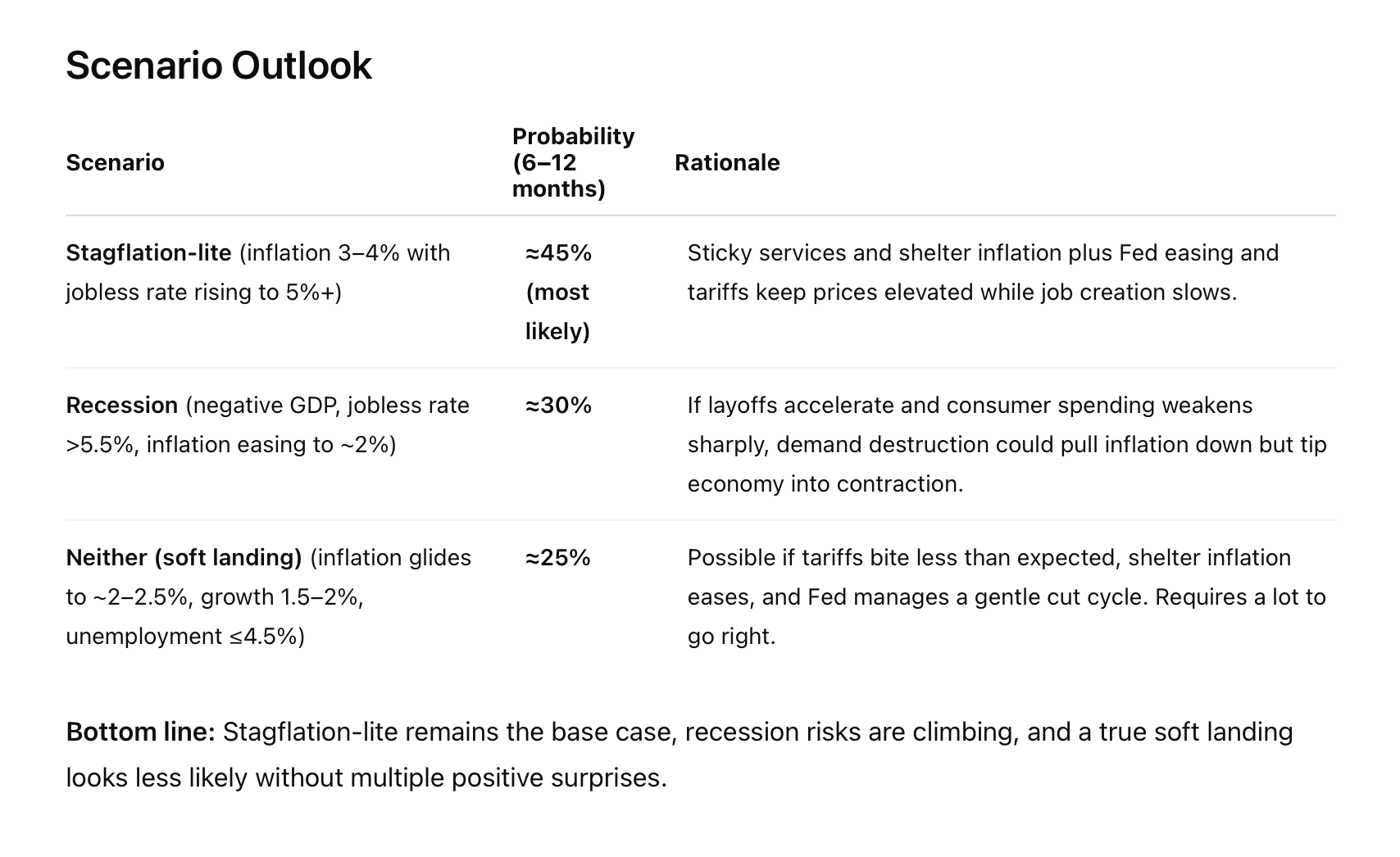
Stagflation probability: 40%
Recession probability: 25%
Neither (slow but stable): 35%
Band: Elevated Risk
15 September 2025
This week showed how fragile the economy feels beneath the surface: inflation is sticky, jobs are softening, and tourism and trade flows are weakening even as the Fed prepares to cut rates. The risk tilts toward stagflation-lite, with wobbles in labor, commodities, and global politics likely to ripple further into the holiday season.
Inflation remains sticky at just under 3 percent and shelter costs are still pushing higher. The labor market is softening more quickly than official headlines suggest, with payroll growth almost stalling and unemployment creeping up to 4.3 percent. Black unemployment surged to 7.5 percent, a reminder that downturns rarely hit evenly. Long-term joblessness is rising too, a classic late-cycle marker.
On the demand side, consumer sentiment dropped to its lowest point in four months, with middle and lower income households leading the decline. Early holiday retail forecasts are already being revised down, suggesting households are tightening before peak spending season. Housing is showing faint signs of stability with supply at 4.6 months, but affordability remains stretched and mortgage rates above 6.5 percent continue to bite. Commercial real estate remains the largest structural red flag, with office delinquencies above 7 percent.
Major headlines also shaped sentiment. Reports that the U.S. and China have reached a “framework” deal on TikTok lifted markets briefly, but details remain thin and Beijing has not confirmed. At the same time, pressure on the Fed to cut rates appears to have succeeded, with a decision expected this week. That raises the risk of easing into sticky inflation, a classic stagflation trap. Meanwhile, agriculture and trade remain stressed: China has not purchased any U.S. soybeans for the new crop year, pushing cash prices below $9 per bushel in some regions, and U.S. timber exports continue to weaken as Chinese demand for hardwood furniture slows. In labor-intensive manufacturing, the DHS raid at the Kia battery plant in Georgia, where hundreds of South Korean workers were arrested, has rattled investment confidence in advanced manufacturing projects. Tourism in D.C. and Chicago is also showing signs of strain amid political rhetoric and security crackdowns. Tourism to the US is down about $12B from last year, and a drag on the GDP of .1-.2 percentage points by itself.
Other important headlines that will factor into our economic reporting: Bolsonaro’s conviction could spark new economic fighting with Brazil. Brazil is already set up to provide China with soybeans and beef to counter the US market. On top of that India and China are straightening their relationships after Trump’s tariffs have fractured US/India relations. They are the 4th and 10th largest economies respectively.
Looking ahead, markets are focused on the Fed’s policy meeting midweek. Jobless claims will offer an early signal of whether layoffs are broadening. Housing starts and permits at week’s end will show whether builders still see demand in the face of high rates. And PCE inflation later this month will test whether the Fed’s preferred measure is cooling enough to justify more than one rate cut.
The balance of risks continues to tilt toward stagflation-lite: growth flat, jobs weaker, inflation sticky. But a sharper downturn cannot be ruled out if labor weakness deepens and consumers retreat further into the holidays.
Quick-Read Dashboard
Inflation (CPI, YoY): 2.7% | Core (YoY): 3.1% | 1-month: +0.2%
Unemployment rate: 4.3%
Nonfarm Payrolls (Aug): +22k — weakest pace outside recessions
Fed funds target range: 4.25–4.50% (cut expected imminently)
GDPNow (Q3 real growth nowcast): ~2.0%
Manufacturing PMI (ISM): 48.9 (contraction)
Composite PMI (S&P Global): 54.6 (expansion)
10y–2y Treasury spread: ~+0.6% (no longer inverted, but flat)
High-Yield credit spread (HY OAS): ~2.9% (tight)
30-yr mortgage (Freddie Mac): 6.58%
Existing-home sales (SAAR): 4.01M, months’ supply 4.6
Housing starts (SAAR): 1.43M (single-family ~0.94M)
CRE stress: CMBS delinquency elevated (esp. office)


New Relevant Statistics to Track / Add Moving Forward
Long‑term unemployment, especially 27‑plus weeks, as % of total unemployed. Already rising.
Consumer inflation expectations, especially among low and middle incomes. Recent rise to ~3.9% mentioned.
Job revisions and how much earlier estimates were overstated (e.g. over 900,000 jobs revised downward). This matters because policy and sentiment react to data reported, not revised.
Tightness in housing/rental supply and changes in “owners’ equivalent rent” or rent of primary residences inflation (lagging indicators).
Weekly initial jobless claims (national & local) as early warning.
Consumer sentiment / expectations indices (Michigan etc.).
Takeaway: Growth is fragile, inflation sticky, labor softening. Housing activity weak but stabilizing; CRE remains the deepest structural stress.
Sources: Bureau of Labor Statistics, Bureau of Economic Analysis, Federal Reserve, Atlanta Fed GDPNow, U.S. Census Bureau, NAR, MBA, Department of Labor, Treasury/FRED, ICE/BofA, S&P Global, ISM, University of Michigan, Conference Board, USDA, FAO, Trepp, Moody’s/Fitch/S&P, TSA, EIA, American Soybean Association, National Hardwood Lumber Association, Reuters, Bloomberg, WSJ, Financial Times, Politico, The Hill, NPR, AgWeb, Farm Policy News. Internal analytics: Stagflation Index, Structural Risk Index, Retirement Defense Checklist, Early House-Sale Triggers, Where Could We Land? Tracker.